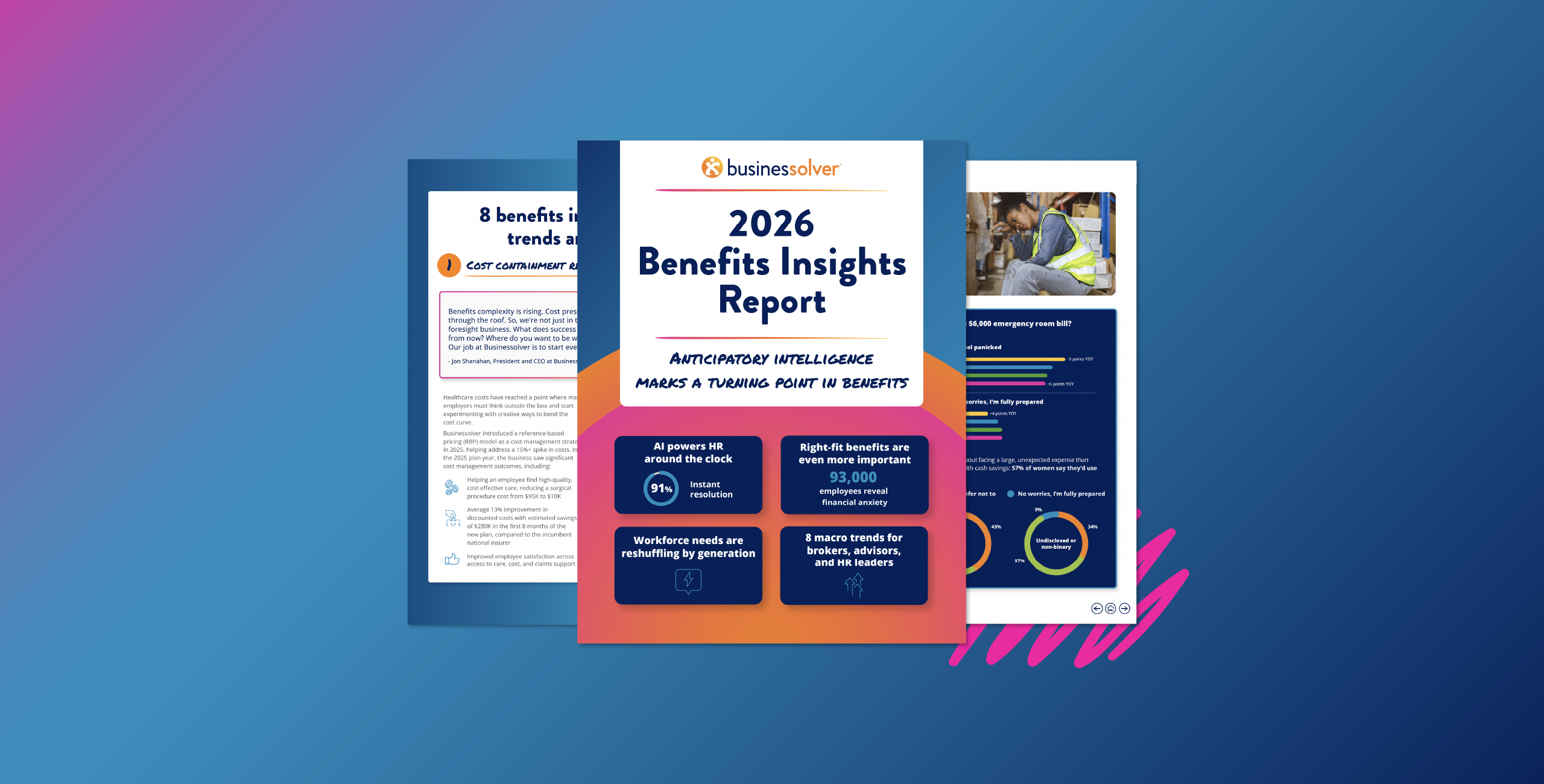
For years, personalization—tailoring user content based on preferences, claims, and past choices—was the buzzword in our employee benefits industry.
While personalization remains foundational technology, we need to address a growing truth: Personalization is not enough.
Here’s why:
We believe employees, HR, and our industry partners should not shoulder the burden of a confusing healthcare system in lieu of delivering results, driving positive outcomes, and enabling their workforce to be as healthy and happy as they deserve to be.
So, at Businessolver, we’re shifting our definition of success to how our platform helps people avoid the scramble and confusion in the first place.
That shift comes to life through Sofia—our AI engine. Since 2017, Sofia has evolved from a virtual assistant into the intelligence layer that powers the entire Benefitsolver platform.
Sofia connects data and experiences across systems, so she can recognize when someone is asking for help—and when they’re drifting toward a need they haven’t put into words yet. It’s not prediction for prediction’s sake, but readiness and prevention: meeting people before the moment turns into a flood of tickets, escalations, missed deadlines, unexpected costs, and frustration.
For example, instead of notifying an employee after a missed enrollment deadline, Sofia identifies risk signals weeks earlier and proactively delivers guidance, reminders, and support—reducing errors and stress before they occur.
But anticipation isn’t just about prevention. It’s about in-the-moment strategy:
Anticipatory insights will change what’s possible for HR leaders—putting them in the driver’s seat with real-time, dynamic data that reduces manual analysis, improves service outcomes, and enables strategic agility.
As an F1 fan, I can’t help but relate this anticipatory shift to racing. F1 is hands down the most technologically advanced sport. Racers don’t win by looking in the rearview mirror; they act on real-time intelligence—speed, tire pressure, braking, and inputs that anticipate cornering efficiency. These metrics inform split-second strategy calls.
Similarly, HR operates under constant pressure and motion. To win in an environment where healthcare costs outpace inflation and employee needs are ever-evolving, leaders require more synchronous inputs that get ahead of risk and reveal strategic opportunities.
Anticipatory insights close the timing gap—helping employees and HR teams see what’s coming, recognize patterns earlier, and act with confidence. It’s a shift from event-driven support to an always-on, intelligent, and measurable enablement engine that helps employees and HR make better decisions in the moment.
This context matters because anticipation isn’t just Sofia, a single feature, or system.
Anticipation is empathy in action, at scale. It’s what happens when human expertise and service are amplified by intelligence that knows when, where, and how to step in, before a moment becomes a problem.
To power anticipation, we’re reimagining benefits intelligence—bringing together a richer, more complete data set so employees, HR, and partners get the right information, support, and insights at the right time, including:
To me, anticipation is more than foresight or prediction. It possesses an essence of optimism—of promise—built on a foundation of empathy.
At Businessolver, our mission has always been to grow our business and delight our clients. A natural deliverable of that mission is a commitment to responsible and continuous innovation.
I knew in 1998, when I founded Businessolver, that there was a better way to do benefits administration—and it all started with a singular aspiration—to simplify benefits. Back then, benefits administrators were buried in paper and still working on last year’s enrollment when the next AE season rolled around.
The point is, we don’t have to accept the challenges of today—complexity, confusion, costs—as inevitable. We must act and think more creatively and proactively to meet them.
Anticipation is the next natural step in our mission to delight. And I’m genuinely energized by it—because in true “Solver” spirit (as we call ourselves at Businessolver) we’re never satisfied with “good enough.” We’re driven by what’s possible, and we’re constantly pushing toward what’s next.
If you’ve stayed with me to the end, my one thing is this: We want to solve with you. This is a hard business, and there aren’t always thank-yous. But together, we can build a future of benefits administration powered by anticipatory insights and people—where HR teams get ahead of tomorrow’s problems and employees finally thrive.
Because the end of the personalization era holds the promise of something much better—and we’re just getting started.
Cheers,
Jon Shanahan
Businessolver President and CEO