
Employees are dropping not-so-subtle hints that their wellbeing and workplace experience may not be as rosy as it looks from the C-suite.
Our latest C-suite Special Reports reveal how C-suite executives (CXOs) are operating under a remarkable cluster of mental health strain, toxicity, intimidation, and fear of acting on empathy, all amidst a shared reality problem. In fact, 40% of CHROs and CPOs say they feel intimidated by coworkers and 37% say their culture is toxic. That doesn’t paint a picture of the best employee experience.
While the struggle is real in the C-suite, employees are feeling it even more: 55% say they experienced a mental health issue in the past year, compared with 33% of CXOs, a 22-point experience gap. And mental health is not the only place where views diverge. Employees are more than 2X as likely to see empathy as a retention driver compared with CXOs. Meanwhile, workplace flexibility looks far more available from the CEO’s chair than it does to employees.
Growth should normally come with a gold star. But the data shows strong financial performance doesn’t necessarily mean employees are doing ok.
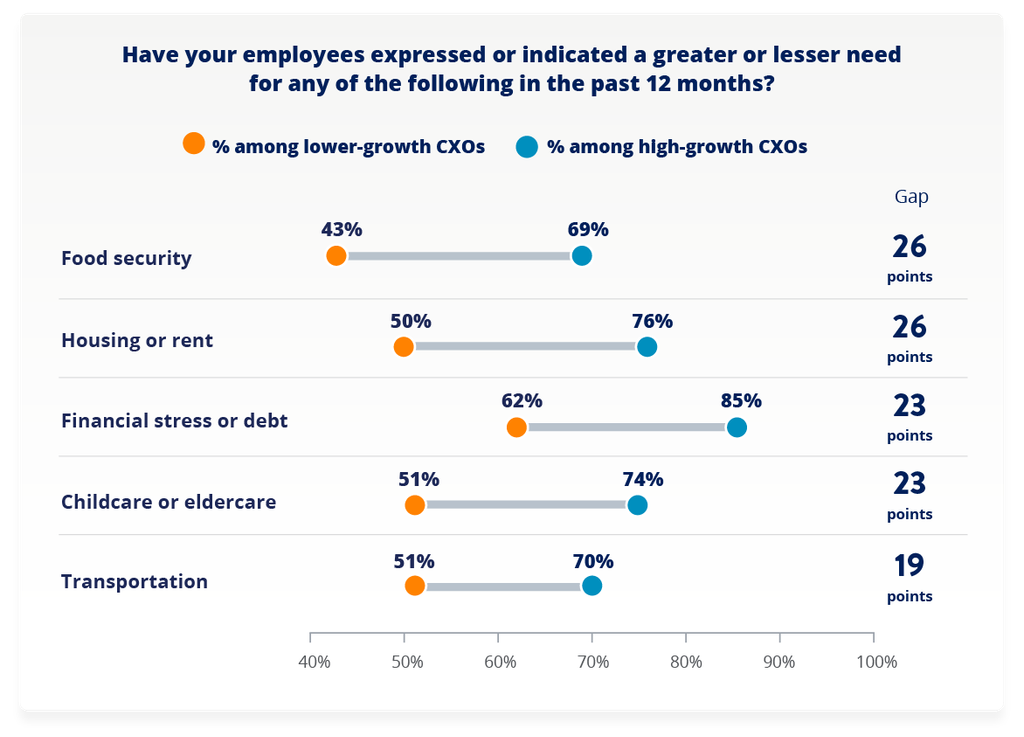
CXOs who report significant financial growth in the past year also cite greater employee demand across every social determinant of health measured, including financial support, food security, housing, transportation, and caregiving. Even so, these high-growth CXOs report lower investment in employee benefits than their peers.
Our 2026 Benefits Insights Report helps explain the heightened demand for SDOH-related support: Only 15% of employees feel fully prepared to cover a $6,000 emergency room bill, while 34% would go into debt or don’t know how they’d pay it.
Together, the findings point to more of what you already know. Times are tough. But ironically, they might be even tougher at companies experiencing strong financial growth.
This underscores how important it is to dig beneath surface-level data. Benefits can look impressive on paper and still leave employees vulnerable. The opportunity is to look beyond claims and utilization to understand and anticipate which populations need greater support, such as timely reminders, navigation support, mobile access, and affordability-driven benefits. It’s not always about adding more benefits but helping employees find and use the right ones at the right time.
Learn more about the insights that can boost employee engagement in our Industry Benchmarks report.
Short answer: Probably not. If you think your employees are struggling, chances are they’re struggling even more.
Employees and CXOs report similar levels of coworker intimidation, at 33% and 34%, respectively. But that’s where the similarity ends. This year, 55% of employees cite a mental health issue compared with 33% of CXOs, a 22-point experience gap. Among those affected, employees are 4.5X more likely than CXOs to report depression and 5X more likely to report loneliness or isolation.
These gaps in wellbeing underscore how employees might not be doing as well as leaders think. HR leaders and managers alike shouldn’t wait for claims data, annual reviews, and employee pulse surveys. Check the data and check in regularly. Talk openly about mental health and reinforce where employees can find help.
Most importantly, make it OK to not be OK. Employees should be able to raise their hand, drop the “I’m fine” face, and ask for help without worrying about stigma or career consequences.
The C-suite looks to the top, naming CEOs and CHROs/CPOs as having the most influence on building an empathetic workplace. Employees see culture as more of a team sport: 32% of employees (who are not in manager roles) say they have the greatest influence on workplace culture, while only 9% name HR. Just 2% of CXOs identify employees as culture’s biggest influencers.
But while chief people leaders are expected to help carry the culture banner, they also cite the most trepidation with that responsibility: 48% of CHROs and CPOs say empathy is difficult to demonstrate consistently.
Culture isn’t the responsibility of one or two people, or even the C-suite itself. While leaders may set the tone, employees make culture real through lived experiences and daily interactions. Give employees a meaningful voice in shaping culture, hold the entire leadership team accountable for it, and make sure HR leaders have the support to stay healthy themselves.
Employees are 2X more likely than CXOs to connect empathy in the workplace with lower turnover. And CEOs are the least likely to view empathy as a retention driver. Only 27% of CEOs connect empathy with lower turnover, even though 73% say employees are entitled to it.
Employees are likewise assigning real economic value to empathy: 66% would accept lower pay to work for a more empathetic employer, rising to 78% among Gen Z employees.
That’s no casual tradeoff amid rising healthcare costs, financial strain, and uncertainty. It’s a bright red flag indicating how much value employees place on psychological safety, supportive managers, and cultures where they feel supported.
Among the C-suite, CHROs and CPOs are most likely to prioritize AI investment for speed, productivity, and time savings at 49%. Yet, at just 27%, they’re the least likely among their CEO, CIO, CTO, and CFO peers to prioritize AI investment for upskilling and personalized learning.
At many organizations, HR leads AI transformation, so when AI upskilling takes a back seat, it could undermine the very efficiency outcomes that leaders are seeking from AI.
Our AI report shows 49% of employees say they’ve been left to figure out AI on their own, 31% worry they’re falling behind, and 39% say AI makes them concerned about their future. But when employees receive adequate employer-sponsored AI training, they’re 1.5 times more likely to report confidence and career acceleration.
AI transformation is only as strong as the people behind it. Making upskilling a priority gives employees the confidence and capability to turn AI investment into business value.
Experience gaps don’t become business risks overnight. They grow quietly, often showing up in workforce data long before they appear in turnover, healthcare costs, or productivity measures.
The organizations best positioned to support employees aren’t waiting for annual surveys or major challenges to surface. They’re looking for signals earlier, paying attention to where employee experiences differ from leadership perceptions, and taking action before small gaps become bigger problems.
Whether it’s mental health, financial wellbeing, workplace culture, empathy, or AI readiness, the goal isn’t simply to collect more data. It’s to understand what employees are experiencing and use those insights to make better decisions.
Employers who can identify those signals early are better positioned to support employees, adapt benefits strategies, strengthen engagement, and move forward with confidence.