
When we think about benefits risk, macro challenges like rising costs, plan utilization, claims, and aging employee populations come to mind. But our latest Benefits Insights Benchmarks Report points to industry as a leading determinant of benefits risk, driven largely by benefits literacy and financial readiness.
Looking at the data across more than 93,000 Benefits Literacy Benchmark responses, we found industry emerged as one of the strongest predictors of benefits literacy. In fact, benefits knowledge varies sharply by income and industry, with software employees scoring 59% versus 32% accuracy among retail employees—a 27-point difference. That’s a much larger gap than we see when comparing literacy scores across generations.
Employees working in non-desk industries often experience benefits differently than office or desk-based workers. Compared with desk-based employees, many are experiencing heightened financial stress due to lower wages alongside physically demanding jobs and more rigid scheduling. While these employees value their benefits, they frequently lack the time, access, or confidence needed to navigate an increasingly complex web of healthcare and benefits decisions.
The risks? Delayed care, underutilized benefits, increased confusion, and greater financial stress—making benefits literacy not just an education issue, but a workforce risk issue. But the good news is that these risks are increasingly visible and preventable.
Here’s how the 3 non-desk industries featured in our report—hospitality, healthcare, and manufacturing—stack up in terms of lifestyle risk, benefits literacy, financial readiness, and benefits preferences and engagement.
Among the 5 industries our report studied, hospitality and retail employees demonstrate the lowest benefits literacy score at just 37%. At the same time, 45% say they would panic over a $6,000 emergency room bill.
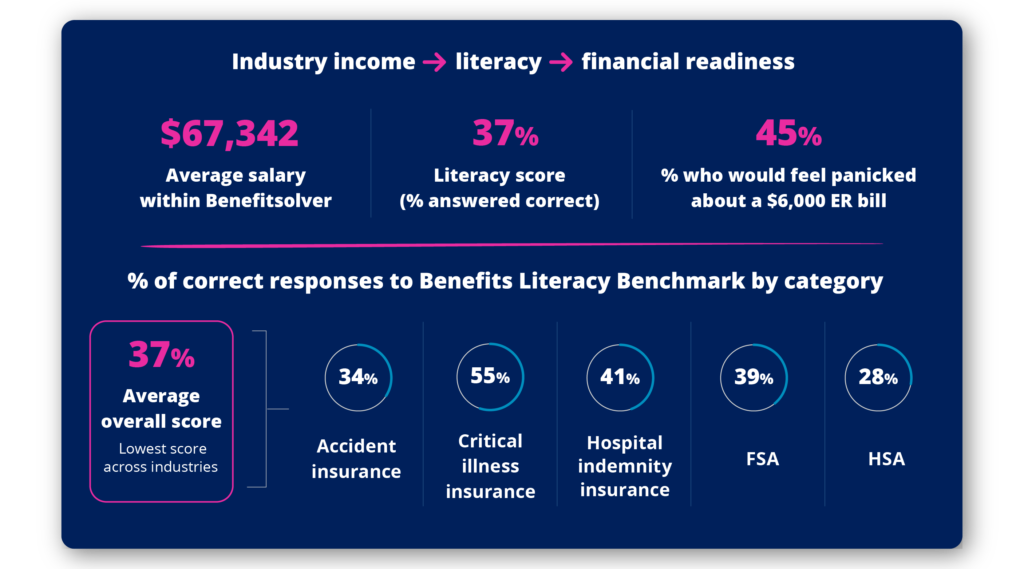
This population, which has the highest concentration of female and younger workers across the industries we studied, self-describes as healthier than other populations:
Our data shows how these employees gravitate toward affordability-driven benefits that reduce financial strain and simplify decisions, including prescription assistance, financial assistance benefits, and telemedicine.
Targeted guidance is especially important for these employees, including tailored recommendations for affordability-driven benefits, after-hours communications, and text reminders that deliver support when employees need it most.
One of the more surprising findings in our report comes from healthcare workers. Healthcare and hospital employees scored just 43% on benefits literacy (that’s lower than manufacturing employees), underscoring how understanding healthcare isn’t the same as understanding benefits.
Additionally, 54% would panic over a $6,000 ER bill, the highest level of financial panic across industries and 25 points higher than finance employees.
At the same time, this workforce demonstrates some of the strongest digital benefits engagement:
For benefits leaders, that’s an important reminder that employees—especially frontline and non-desk-based—need to be able to engage with and activate their benefits from anywhere, making mobile and digital access essential.
Manufacturing employees scored relatively high in benefits literacy at 46%, but this male-dominated population shows high indifference and low benefits engagement, pointing to constraints around benefits access.
These employees value practical, protection-focused benefits that deliver immediate value. At the same time, many benefits offerings generate significant levels of indifference, likely because this population has limited time and opportunity to take advantage of benefits outside of core needs.
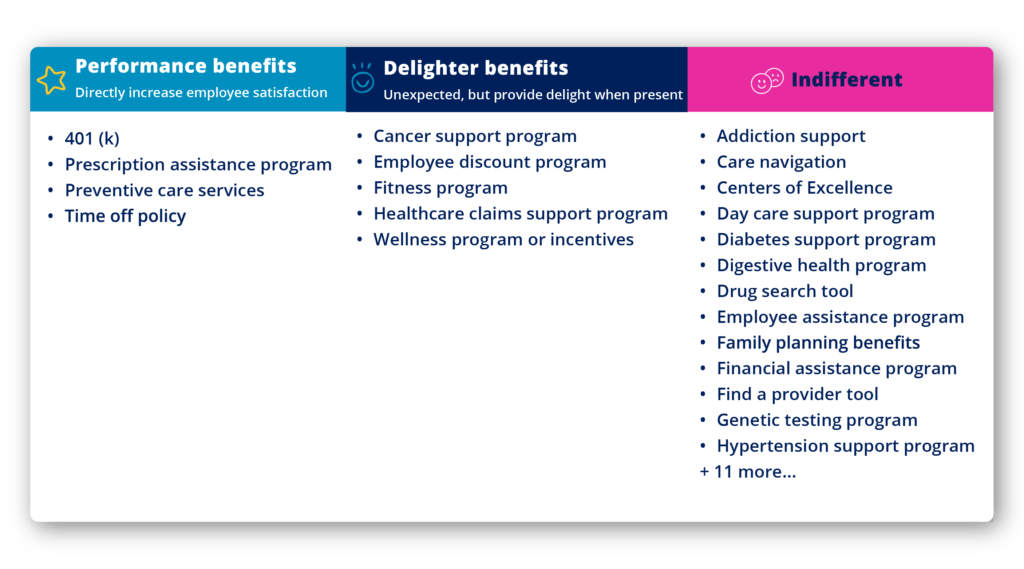
It’s not that these benefits aren’t valued. It’s more likely that this population simply needs proactive guidance, easy ways to take action, and frequent reminders, especially before and after normal work hours.
For these employees, who are often constrained by rigid scheduling and front-line work, engagement strategies should include:
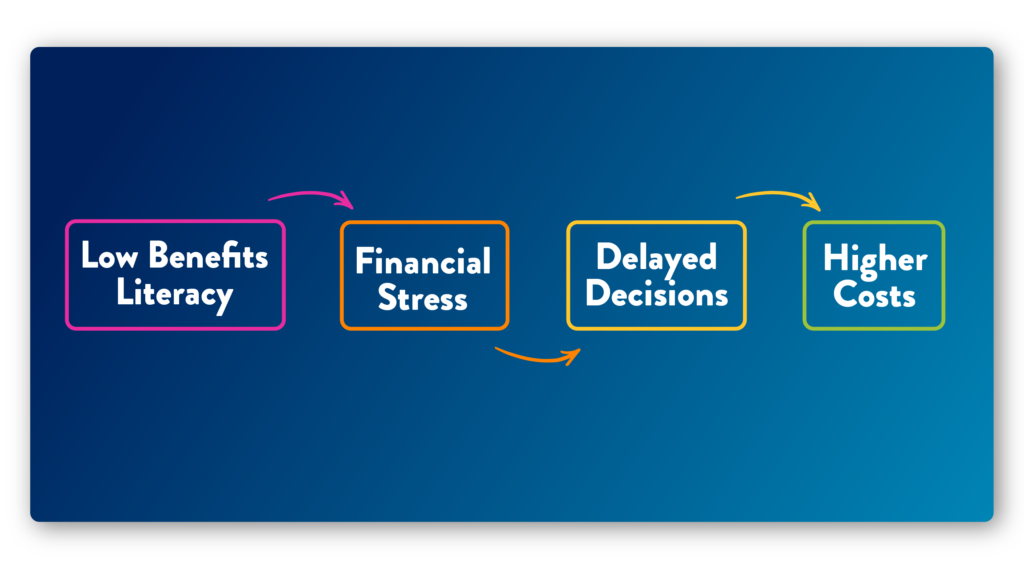
Age is often seen as an obvious risk. But our data shows how industry is a strong determinant of workforce behaviors, benefits literacy, and salary-driven financial stress.
When employees don’t understand how their benefits work, don’t know where to get help, or delay care, risk builds long before it appears in claims data. And that’s especially true for non-desk populations.
We can’t control the cost of healthcare, but we can make benefits investments work harder and more effectively for everyone. And it all starts with helping employees choose and use their benefits with greater confidence. This can be done through targeted communications, mobile access, timely notifications, and AI-driven guidance that anticipates their needs.
By understanding where challenges exist and addressing them proactively, we can help employees navigate their benefits with greater confidence while making benefits investments work harder for everyone.